Nothing announces a Sunday morning in Pakistan quite like a plate of halwa puri, and the puri is the part that makes or breaks it. This puri recipe gives you round, balloon-puffed breads that are crisp at the edges and soft inside, with no greasy aftertaste and no flat, chewy duds.
The method is simple once you understand two things: puri dough must be stiffer than roti dough, and the oil must be properly hot. A spoonful of sooji adds a light crispness that holds the puff, so your puris stay plump on the plate long enough to scoop up chana and halwa.
Why This Puri Recipe Works
Most puri problems come down to dough texture and oil heat. A soft dough soaks up oil and refuses to puff, while cool oil leaves the puri pale and heavy. This version uses a firm dough enriched with a little fat, rests it so it rolls easily, and fries at a steady temperature for just seconds per side. The result is a puri that is light, golden and pleasantly crisp without being hard.
It also uses everyday chakki atta, so you do not need a special flour. If you prefer the lighter, whiter puris served by halwa puri shops, there is an easy swap below. Either way, the technique stays exactly the same.
Ingredient Guide
- Chakki atta: Gives flavour and a pleasant chew. For shop-style puris, use half atta and half maida, or all maida for the lightest version.
- Sooji (semolina): Adds crispness and helps puris stay puffed. Use fine sooji so the dough remains smooth. You can leave it out, but the puris soften faster.
- Oil or ghee in the dough: A small amount makes the puri tender and flaky rather than tough.
- Sugar: Optional. It gives an even golden colour without adding noticeable sweetness.
- Frying oil: Any neutral oil with a high smoke point works, such as sunflower, canola or vegetable oil. Fresh oil gives the cleanest flavour.
Puri Recipe: Puffy, Golden Fried Bread for Halwa Puri Breakfast
Pakistani · Breakfast · Medium
Ingredients
- 250 g chakki atta (whole wheat flour), about 2 cups
- 50 g fine sooji (semolina), about 1/3 cup
- 1/2 tsp salt
- 1 tsp sugar (optional, for colour)
- 1 tbsp oil or ghee, for the dough
- About 130 ml water (just over 1/2 cup), as needed
- Oil for deep frying, about 750 ml (3 cups)
Method
- Mix the atta, sooji, salt and sugar. Rub in 1 tbsp oil until the mixture feels like breadcrumbs.
- Add water a little at a time and knead into a firm, smooth dough, stiffer than roti dough. Knead for 4 to 5 minutes.
- Cover and rest for 20 minutes.
- Heat the oil in a deep karahi or wok to about 180 to 190°C (350 to 375°F). A small piece of dough should rise to the surface immediately.
- Divide the dough into 16 small balls. Lightly oil the rolling surface and roll each ball into a 10 to 12 cm circle of even thickness, about 2 mm.
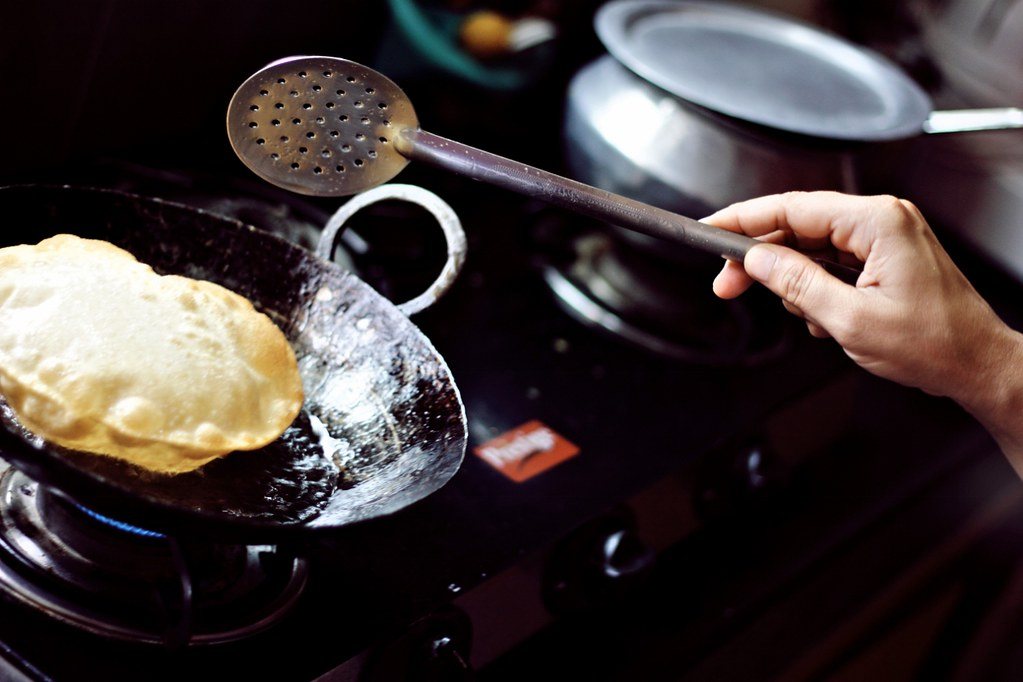
- Slide one puri into the hot oil. Gently press it under the surface with a slotted spoon until it puffs, about 10 seconds.
- Flip and fry the other side for 15 to 20 seconds until light golden.
- Lift out, drain on a rack or paper towels, and repeat with the remaining dough. Serve hot.
Step-by-Step Walkthrough
Making a Firm Dough
Add water slowly. You are aiming for a dough that is firm and smooth, almost like play dough, which holds its shape when pressed. If you press a finger into it and the dent stays sharp, it is right. A stiff dough absorbs less oil and creates the steam pocket that makes puris puff.
Resting
Twenty minutes is enough for the sooji to absorb moisture and the gluten to relax. Do not rest it for hours, as the dough can soften too much.
Rolling
Use a few drops of oil on the rolling board instead of dry flour. Flour falls off into the hot oil, burns and darkens the oil quickly. Roll each puri to an even thickness all over. Thin edges with a thick centre, or a tear in the dough, will stop it from puffing properly. Roll a few at a time and keep them covered so they do not dry out.
Frying
Test the oil with a small pinch of dough: it should sizzle and rise straight up. Slide the puri in gently away from you to avoid splashing. As soon as it floats, press it lightly with a slotted spoon. This pushes the steam to expand, and the puri inflates like a balloon. Flip once and fry briefly until golden, then drain. Fry one at a time if you are new to this; with practice you can roll the next while one cooks. Keep an eye on the heat between batches, nudging the flame up or down so the oil stays in the right range, because each cold puri briefly lowers the temperature.
Troubleshooting Tips
| Problem | Likely cause | Fix |
|---|---|---|
| Puris not puffing | Oil not hot enough or uneven rolling | Heat the oil more and roll evenly |
| Oily puris | Soft dough or cool oil | Knead a stiffer dough; keep oil at 180°C or above |
| Hard puris | Too much sooji or overfrying | Reduce sooji and fry just until golden |
| Dark spots | Flour burning in oil | Roll with oil instead of dry flour |
Variations and Serving Ideas
For masala puri, add half a teaspoon each of ajwain, red chilli powder and kasuri methi to the dough. Palak puri uses spinach puree in place of some water for a green colour and gentle earthy flavour. For a festive sweet version, knead the dough with a little sugar and fennel seeds.
The classic pairing is a full halwa puri breakfast: sooji halwa, spicy chana masala, aloo bhujia, pickle and a cup of chai or a glass of lassi. Puris are also lovely with a simple aloo sabzi, chicken qorma or a bowl of sweet kheer.
Storing Puris
Puris are at their best within minutes of frying, when they are still puffed. Leftovers keep in an airtight container for up to a day. They will deflate but remain tasty; reheat for a few minutes in a 160°C oven to bring back some crispness. The raw dough can be wrapped and refrigerated for up to a day. Bring it to room temperature and knead briefly before rolling.
Frying oil that is still clean can be strained through a fine sieve once cool and reused once or twice for similar frying. Discard it if it smells strong, looks dark or smokes at normal frying heat.
Puri FAQs
Why does this puri recipe use a stiffer dough than roti?
A firm dough absorbs less oil and holds the trapped steam that makes the puri puff. A soft roti-style dough gives flat, oily puris.
Can I make puris in advance for guests?
Roll them up to an hour ahead, stacked between oiled baking paper and covered, then fry just before serving. Fried puris lose their puff within about thirty minutes.
Can I make puris without sooji?
Yes. Use all atta or a mix of atta and maida. They puff just as well but soften a little sooner after frying.
What is the best oil temperature for puris?
About 180 to 190°C (350 to 375°F). Lower than this and they absorb oil; much hotter and they brown before they can puff.
Master this puri recipe and you hold the key to the most loved breakfast of the week. Keep the dough firm, the oil hot and the chai ready.