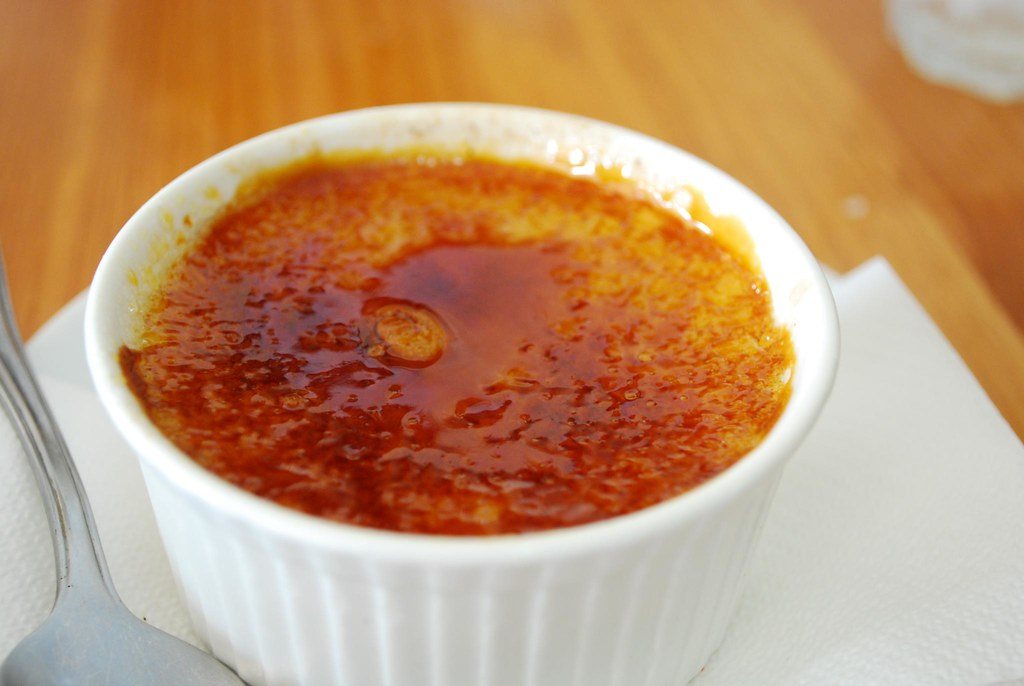
There is something deeply satisfying about tapping a spoon through a glassy sugar crust into cool, silky custard. This crème brûlée recipe gives you exactly that, with only five ingredients: cream, egg yolks, sugar, vanilla and a pinch of salt. It is elegant enough for a dinner party and surprisingly easy to make a day in advance.
The secret to a great version is gentle baking. A low oven and a water bath cook the custard slowly so it sets smoothly without bubbles or a scrambled edge. Then, just before serving, a thin layer of sugar is caramelised with a kitchen torch or under a hot grill until it crackles.
Why This Recipe Works
Many people assume crème brûlée is restaurant-only food, but it is one of the most forgiving custards you can make at home. There is no flour or cornflour to cook out, and the oven does most of the work. Using only yolks, rather than whole eggs, gives a richer, creamier set, and warming the cream first helps the custard bake evenly and shortens the cooking time.
It also suits busy hosts. The custards need several hours in the fridge, so you can bake them in the morning or the night before and simply torch the tops when it is time for dessert.
Choosing Your Ingredients
- Double cream or heavy cream: Look for cream with around 35 to 48 percent fat. In Pakistan, imported whipping cream or locally available cooking cream with high fat both work, though very thin cream will set more softly. A mix of cream and a little whole milk lightens it slightly.
- Egg yolks: Large, fresh yolks. Save the whites for meringues or an egg-white omelette.
- Caster sugar: Fine sugar dissolves quickly in the custard and caramelises evenly on top. If you only have granulated sugar, blitz it briefly in a grinder.
- Vanilla: A split vanilla pod gives beautiful specks and the deepest flavour. Good vanilla extract or paste is a perfectly fine substitute.
- Salt: Just a pinch to round out the sweetness.
Crème Brûlée Recipe: Silky Vanilla Custard with a Crisp Top
French · Dessert · Medium
Ingredients
- 500 ml double cream or heavy cream
- 1 vanilla pod, split and seeds scraped, or 2 tsp vanilla extract
- 6 large egg yolks
- 80 g (1/3 cup + 1 tbsp) caster sugar
- A pinch of salt
- 6 tbsp caster sugar for the topping
Method
- Preheat the oven to 150°C (300°F), or 140°C fan, and boil a kettle of water.
- Heat the cream with the vanilla seeds and pod until steaming, then infuse for 10 minutes.
- Whisk the egg yolks, sugar and salt until just combined, then slowly pour in the warm cream while whisking gently.
- Strain the custard into a jug, skim off any foam, and pour into 6 shallow ramekins.
- Place the ramekins in a roasting tin and add hot water to come halfway up their sides.
- Bake for 30 to 40 minutes until the edges are set and the centres wobble slightly.
- Cool for 30 minutes, then cover and chill for at least 4 hours or overnight.
- Just before serving, sprinkle a thin layer of sugar on each and caramelise with a blowtorch or under a very hot grill; rest for 2 minutes before serving.
Step-by-Step Guide
Infuse the cream
Heat the cream with the vanilla seeds and pod until it is steaming and small bubbles appear around the edge. Do not let it boil hard. Turn off the heat and let it infuse for 10 minutes if you are using a pod; with extract you can skip the wait and stir it in at the end.
Mix the custard gently
Whisk the yolks, sugar and salt in a bowl just until combined and slightly paler. Then pour in the warm cream slowly, whisking gently all the time. The aim is to blend, not to beat in air; foam on the custard becomes bubbles on the finished surface. Strain the mixture through a fine sieve into a jug and skim off any foam.
Bake in a water bath
Set shallow ramekins in a deep roasting tin and fill them almost to the top. Pour hot water into the tin until it comes halfway up the sides of the ramekins. Bake at 150°C (300°F), or 140°C for a fan oven, for 30 to 40 minutes. They are ready when the edges are set and the centres wobble like jelly when gently shaken. If you have a thermometer, the custard should read about 80°C (176°F) in the centre.
Chill thoroughly
Lift the ramekins out of the water, cool for 30 minutes, then cover and chill for at least 4 hours, ideally overnight. The custard firms up considerably as it cools.
Caramelise the top
Blot any moisture from the surface with kitchen paper. Sprinkle an even, thin layer of sugar over each custard, tilt to spread it, and tip out the excess. Move a blowtorch flame in small circles just above the sugar until it melts and turns deep amber. Let it sit for a couple of minutes so the caramel hardens.
Tips for a Flawless Finish
- Shallow dishes set more evenly. Wide, shallow ramekins give more crunchy top per spoonful and cook more consistently than deep ones.
- Do not overbake. If the centre is completely firm in the oven, it will turn grainy once chilled.
- No torch? Place the chilled custards under a very hot grill, close to the element, for 1 to 3 minutes, watching constantly. The custard may warm slightly, so chill again briefly if needed.
- Two thin layers of sugar, torched one after the other, give a thicker, more even crust than one heavy layer.
- Torch close to serving. After about an hour in the fridge the crust starts to soften and turn sticky.
Flavour Variations
Once you have mastered the basic crème brûlée recipe, it is easy to adapt. Infuse the cream with lightly crushed cardamom pods and a few saffron threads for a desi-inspired version that tastes a little like kheer. Add a tablespoon of instant coffee to the hot cream for a coffee brûlée, or stir in finely grated orange zest. Chocolate lovers can melt 60 g of dark chocolate into the warm cream before mixing with the yolks. A few raspberries or slices of fresh mango placed in the ramekins before pouring in the custard add a fruity surprise at the bottom.
Storage and Make-Ahead
Baked, untorched custards keep covered in the fridge for up to 3 days. Because they contain eggs and cream, always keep them chilled and do not leave them out for more than two hours. Once torched, they are best eaten within an hour. Freezing is not recommended because ice crystals spoil the silky texture.
Frequently Asked Questions
Why is my crème brûlée runny?
It was underbaked or not chilled long enough. Next time, bake until only the very centre wobbles, and allow a full 4 hours in the fridge.
Why does it have a grainy or eggy texture?
The oven was too hot or the custards baked too long, causing the yolks to curdle slightly. Lower the temperature and always use a water bath.
Can I make this crème brûlée recipe without a water bath?
It is possible at a very low temperature, around 120°C, but the water bath is the simplest way to guarantee an even, smooth set.
Which sugar is best for the topping?
Caster sugar or fine brown sugar. Demerara gives a crunchier, more rustic crust but takes longer to melt evenly.
Can I use whole eggs?
You can replace some of the yolks with one whole egg, but the custard will be firmer and less rich.
Crack Into It
This crème brûlée recipe is proof that impressive desserts can be relaxed to make. Bake ahead, keep them chilled, and save the fun part, the torching and the first crack of the spoon, for the moment your guests are watching.