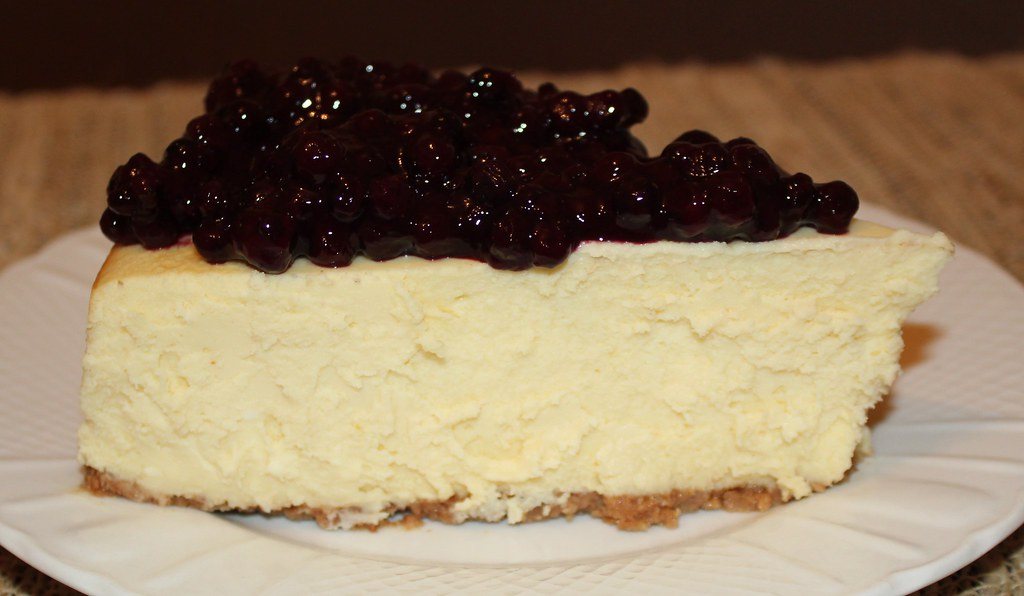
A true New York cheesecake is tall, dense and luxuriously creamy, with a clean tang from cream cheese and soured cream and a crisp, buttery crumb base. It is richer than a light no-bake cheesecake and more velvety than many baked versions, and every slice holds sharp, clean edges.
This recipe focuses on the details that make the difference: room-temperature ingredients, slow mixing to avoid air bubbles, a gentle water bath and a patient cool-down. Follow them and you will get a smooth, pale top with no cracks, without needing any special skills.
What Makes This Cheesecake Different
New York style means more cream cheese and a heavier, richer texture than you find in Italian ricotta cheesecakes or Japanese cotton cheesecakes. The small amount of flour helps the filling set cleanly, while the soured cream and double cream add silkiness. A whisper of lemon lifts the flavour without making it taste citrusy.
- Dense, creamy and smooth from edge to centre.
- Crack-free top thanks to low heat and a water bath.
- Make-ahead friendly: it actually needs a night in the fridge.
- A perfect canvas for fruit, caramel or chocolate toppings.
Before You Start
Take the cream cheese, eggs, soured cream and cream out of the fridge 2 to 3 hours before baking. This is the single most important step. Cold cream cheese forms lumps that need extra beating, and extra beating whips in air that makes the cheesecake puff up, then sink and crack. If you are short of time, cut the cream cheese into cubes and spread it on a plate; it will soften in about 45 minutes.
You also need a springform tin, heavy-duty foil and a roasting tin large enough to hold it.
New York Cheesecake Recipe: Rich, Creamy and Crack-Free
American · Dessert · Medium
Ingredients
- For the base: 200 g digestive biscuits or graham crackers, finely crushed (about 2 cups crumbs)
- For the base: 2 tbsp caster sugar
- For the base: 90 g unsalted butter, melted (6 tbsp)
- 900 g full-fat block cream cheese, at room temperature (4 x 225 g packs)
- 250 g caster sugar (1 1/4 cups)
- 3 tbsp plain flour or cornflour
- 1/4 tsp fine salt
- 2 tsp vanilla extract
- 1 tsp finely grated lemon zest
- 1 tbsp lemon juice
- 4 large eggs plus 1 egg yolk, at room temperature
- 180 ml soured cream (3/4 cup), at room temperature
- 120 ml double cream or heavy cream (1/2 cup), at room temperature
Method
- Heat the oven to 175°C (155°C fan) / 350°F. Wrap the outside of a 23 cm (9 inch) springform tin in two layers of heavy foil and line the base with baking paper.
- Mix the biscuit crumbs, sugar and melted butter, press firmly into the base and bake for 10 minutes. Cool while you make the filling. Lower the oven to 160°C (140°C fan) / 325°F.
- Beat the cream cheese on low speed until smooth, scraping the bowl often.
- Beat in the sugar, flour and salt on low until combined, then the vanilla, lemon zest and juice.
- Add the eggs and yolk one at a time on low speed, mixing only until each disappears.
- Stir in the soured cream and double cream by hand until the batter is smooth.
- Pour over the base, set the tin in a roasting tin and pour in hot water to come halfway up the sides.
- Bake for 70 to 80 minutes, until the edges are set and the centre wobbles slightly like set jelly.
- Turn off the oven, prop the door open a little and leave the cheesecake inside for 1 hour.
- Remove from the water, run a knife around the edge, cool to room temperature, then chill for at least 8 hours or overnight.
Ingredients and Swaps
- Cream cheese: use full-fat block cream cheese. Low-fat or spreadable tub versions are too soft and watery and will not set properly.
- Biscuits: digestive biscuits are widely available in Pakistan and the UK and work beautifully. Graham crackers are the American classic. Tea biscuits or plain butter biscuits also work.
- Soured cream: adds tang and creaminess. You can make a quick substitute by stirring 1 teaspoon of lemon juice into 180 ml of cream and leaving it for 15 minutes, or use thick, strained yoghurt.
- Flour or cornflour: a little starch helps stop cracking and gives a neat slice.
- Eggs: they set the filling. Bring them to room temperature so they blend in quickly.
The Method in Detail
Pressing the Base
Crush the biscuits into fine, even crumbs in a food processor or in a bag with a rolling pin. Press them very firmly into the tin with the bottom of a glass so the base stays crisp and does not crumble when sliced. A short pre-bake sets it.
Mixing the Filling
Use low speed throughout. Beat the cream cheese alone first and scrape down the bowl and paddle often, because lumps hide at the bottom. Once the eggs go in, mix only until each one disappears. Finish by stirring in the creams by hand. Tap the bowl on the counter a few times to bring air bubbles to the surface.
The Water Bath
Baking the tin in hot water keeps the oven humid and the heat gentle, so the filling sets evenly without puffing or cracking. The double layer of foil keeps water out of the springform. If you worry about leaks, set the springform inside a slightly larger cake tin instead of wrapping it.
Knowing When It Is Done
The edges should look set and slightly puffed, while a circle about 8 to 10 cm across in the centre still wobbles when you gently shake the tin. It will firm up fully as it cools and chills. If you use a thermometer, the centre should be around 65 to 70°C (150 to 158°F). Overbaking leads to a dry, grainy texture and cracks.
Cooling Slowly
Sudden temperature changes cause cracks, so let the cheesecake cool inside the switched-off oven, then on the counter, before chilling. Running a knife around the edge early lets it shrink away from the tin without tearing.
Topping Ideas
A plain New York cheesecake is wonderful on its own, but toppings make it special. Try a quick strawberry or mixed berry compote, a thin layer of soured cream sweetened with a little sugar, salted caramel sauce, melted chocolate, or sliced fresh mango in summer. Add toppings just before serving so the surface stays neat.
Storage
Keep the cheesecake covered in the fridge for up to 5 days. It freezes very well: chill it fully, then wrap the whole cake or individual slices in cling film and foil and freeze for up to 2 months. Thaw overnight in the fridge, still wrapped, so condensation does not mark the surface. Because the filling contains eggs and dairy, do not leave slices at room temperature for more than about two hours, especially in hot weather. For the cleanest slices, use a long knife dipped in hot water and wiped dry between cuts.
Frequently Asked Questions
Why did my cheesecake crack?
Common causes are overmixing, overbaking, high heat or cooling it too quickly. Mix on low, bake gently in a water bath and let it cool slowly in the oven.
Can I skip the water bath?
You can place a tray of hot water on the shelf below instead. It helps, but a full water bath gives the creamiest, most even result.
Why is my filling lumpy?
The cream cheese was too cold. Make sure everything is at room temperature and beat the cream cheese alone until completely smooth before adding anything else.
Can I make a smaller New York cheesecake?
Halve the recipe and bake it in an 18 cm (7 inch) springform for around 50 to 60 minutes, watching for the same gentle wobble.
How long does it need to chill?
At least 8 hours, ideally overnight. This is when the texture becomes dense and sliceable.
The Reward for Patience
Baking a New York cheesecake takes time, but very little actual work. Most of it is waiting while the oven and fridge do their job. The reward is a slice that is smooth, rich and creamy, the kind of dessert people remember long after the plates are cleared.