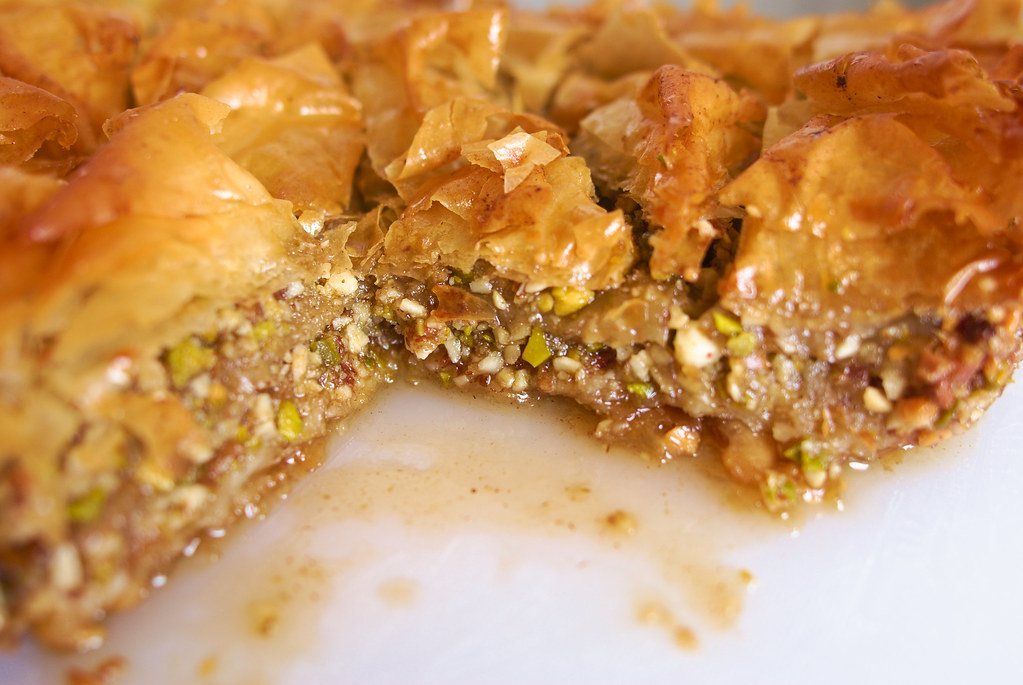
This baklava recipe produces the kind of tray you see in the windows of Turkish and Middle Eastern sweet shops: dozens of thin, golden layers that crackle when you bite them, a generous band of spiced nuts, and a fragrant syrup that soaks right through without turning anything soggy. It looks like a project for professionals, but it really comes down to patience and melted butter.
The key to this version is the temperature rule: cool syrup poured over hot pastry. That contrast is what keeps the top crisp while the inside becomes sticky and rich. Make it a day ahead for Eid, a dinner party or a family celebration, and it only gets better.
Why This Baklava Stands Out
- Two kinds of nuts: walnuts give body and a gentle bitterness, pistachios bring colour and sweetness.
- Balanced syrup: honey for flavour, lemon to cut the sweetness and a hint of rose water for perfume.
- Shop-bought filo: no need to roll your own pastry; standard filo works brilliantly.
- Keeps well: it stays crisp for days at room temperature, so it is ideal for gifting.
About the Ingredients
Filo pastry is the backbone. Thaw it slowly in the fridge overnight; filo thawed at room temperature can turn sticky and tear. Keep the sheets you are not using under a damp, not wet, tea towel so they do not dry and crack.
Butter gives the classic flavour, but the milk solids can brown quickly. Clarified butter or ghee gives crisper layers and a lovely nutty taste, which suits a desi kitchen perfectly. Simply melt butter, let it settle and spoon off the clear fat.
Nuts should be fresh. Taste a walnut before you start; stale walnuts can be bitter. You can use only walnuts, only pistachios, or swap in almonds or hazelnuts. Chop them finely but stop before they turn to powder, or the filling becomes pasty.
Syrup flavourings are flexible. Orange blossom water is common in Lebanese versions, while Greek baklava often uses more honey and a clove or two. Leave out the flower water entirely if you prefer a cleaner honey flavour.
Baklava Recipe: Crisp, Flaky Layers with Honey Syrup and Nuts
Middle Eastern · Dessert · Medium
Ingredients
- 450 g filo pastry (about 20-24 sheets), thawed in the fridge
- 200 g unsalted butter, melted (or ghee)
- 250 g walnuts
- 150 g unsalted shelled pistachios, plus extra for garnish
- 2 tbsp caster sugar
- 1 1/2 tsp ground cinnamon
- 1/4 tsp ground cardamom (optional)
- For the syrup: 250 g (1 1/4 cups) sugar
- 180 ml (3/4 cup) water
- 120 g (1/3 cup) honey
- 1 strip lemon peel and 1 tbsp lemon juice
- 1 cinnamon stick
- 1 tsp rose water or orange blossom water (optional)
Method
- Make the syrup: simmer the sugar, water, honey, lemon peel and cinnamon stick for 10 minutes. Stir in the lemon juice and rose water, then cool completely.
- Preheat the oven to 170°C/340°F (150°C fan). Brush a 23 x 33 cm (9 x 13 in) baking tin with melted butter.
- Pulse the walnuts and pistachios in a food processor until finely chopped but not powdery. Mix with the sugar, cinnamon and cardamom.
- Trim the filo to fit the tin and cover it with a damp tea towel. Layer 8 sheets in the tin, brushing each one with butter.
- Scatter one third of the nut mixture over the pastry. Add 4 buttered sheets, then another third of the nuts, 4 more sheets and the remaining nuts.
- Finish with 8 more sheets, buttering each one, and brush the top generously.
- Using a sharp knife, cut all the way through into diamonds or squares (about 30 pieces).
- Bake for 45-50 minutes until deep golden and crisp.
- As soon as it comes out of the oven, spoon the cooled syrup evenly over the hot baklava. It will sizzle.
- Garnish with chopped pistachios and leave uncovered at room temperature for at least 4 hours, ideally overnight, before serving.
Layer by Layer: The Method Explained
Make the syrup first
The syrup must be completely cool when it meets the hot pastry, so make it before anything else. Simmer it for about ten minutes; it should be the consistency of thin honey. Overcooked syrup sets too firmly and makes the baklava chewy rather than tender.
Butter every sheet
Use a soft pastry brush and work quickly but gently. You do not need to drench each sheet; a light, even coat is enough. Wrinkles and small tears do not matter in the middle layers, so save your neatest sheets for the top.
Cut before baking
Once the pastry is baked it shatters, so cutting it raw is essential. Use a very sharp knife and cut straight down all the way to the bottom of the tin. Traditional shapes are diamonds, made by cutting long parallel strips and then diagonal lines across them, but neat squares work just as well.
Bake low and long
A moderate oven lets the heat reach every layer, so the bottom crisps along with the top. The baklava is ready when it is deep golden all over, not just lightly coloured. Underbaked filo turns soggy as soon as the syrup goes on.
Syrup and rest
Pour the cool syrup slowly over the hot tray, along all the cut lines and around the edges. It will look like too much at first, but the pastry absorbs it over a few hours. Resist covering the tin while it is warm; trapped steam softens the top.
Tips from Experience
- Have everything ready before you unroll the filo: nuts mixed, butter melted, tin greased.
- If your filo sheets are larger than your tin, fold the edges in rather than wasting them.
- Spray the top layer lightly with water just before baking to stop the edges curling.
- For extra crispness, rest the baklava overnight before cutting through again and serving.
- Brush the top layer more generously than the rest; it is the layer people see and taste first.
- Do not refrigerate it; the cold hardens the syrup and dulls the crunch.
Serving, Storing and Gifting
Serve small pieces, as baklava is rich. It is lovely with a cup of strong black tea, Turkish coffee or green tea with mint. A scoop of vanilla ice cream or thick clotted cream alongside makes it into a dinner-party dessert.
Store it uncovered or loosely covered with a clean cloth at room temperature for up to a week. An airtight container is fine after the first day, once the syrup has fully soaked in. To freeze, wrap the unsyruped baked pastry well and freeze for up to 3 months, then warm it briefly in the oven and add fresh syrup. Pack pieces into paper cases and a pretty box for a thoughtful homemade gift.
Frequently Asked Questions
Why is my baklava soggy?
The most common causes are hot syrup on hot pastry, underbaking, or covering it while warm. Follow the cool-syrup, hot-pastry rule and bake until deep golden.
Can I use oil instead of butter?
Yes, a light vegetable oil works and makes the baklava suitable for a dairy-free diet, though you lose some of the rich flavour.
Can I halve this baklava recipe?
Absolutely. Use a 20 cm (8 in) square tin, half the ingredients and start checking at 35 minutes.
What is the difference between Turkish and Greek baklava?
Turkish baklava usually relies on pistachios and a simple sugar syrup, often finished with lemon. Greek versions lean on walnuts, more honey and warm spices such as cinnamon and clove. This baklava recipe sits happily in between, using both nuts and a honey-lemon syrup, so feel free to push it in either direction.
How do I know when the syrup is the right thickness?
It should coat a spoon thinly and drip off easily. It thickens as it cools, so do not reduce it to a thick, sticky stage.
Worth Every Layer
Making baklava at home takes a little time, mostly spent brushing butter onto pastry, but the reward is a tray of golden, crisp sweets that taste far better than many you can buy. Once you have tried this baklava recipe, you may find it becomes your go-to dessert for every celebration.